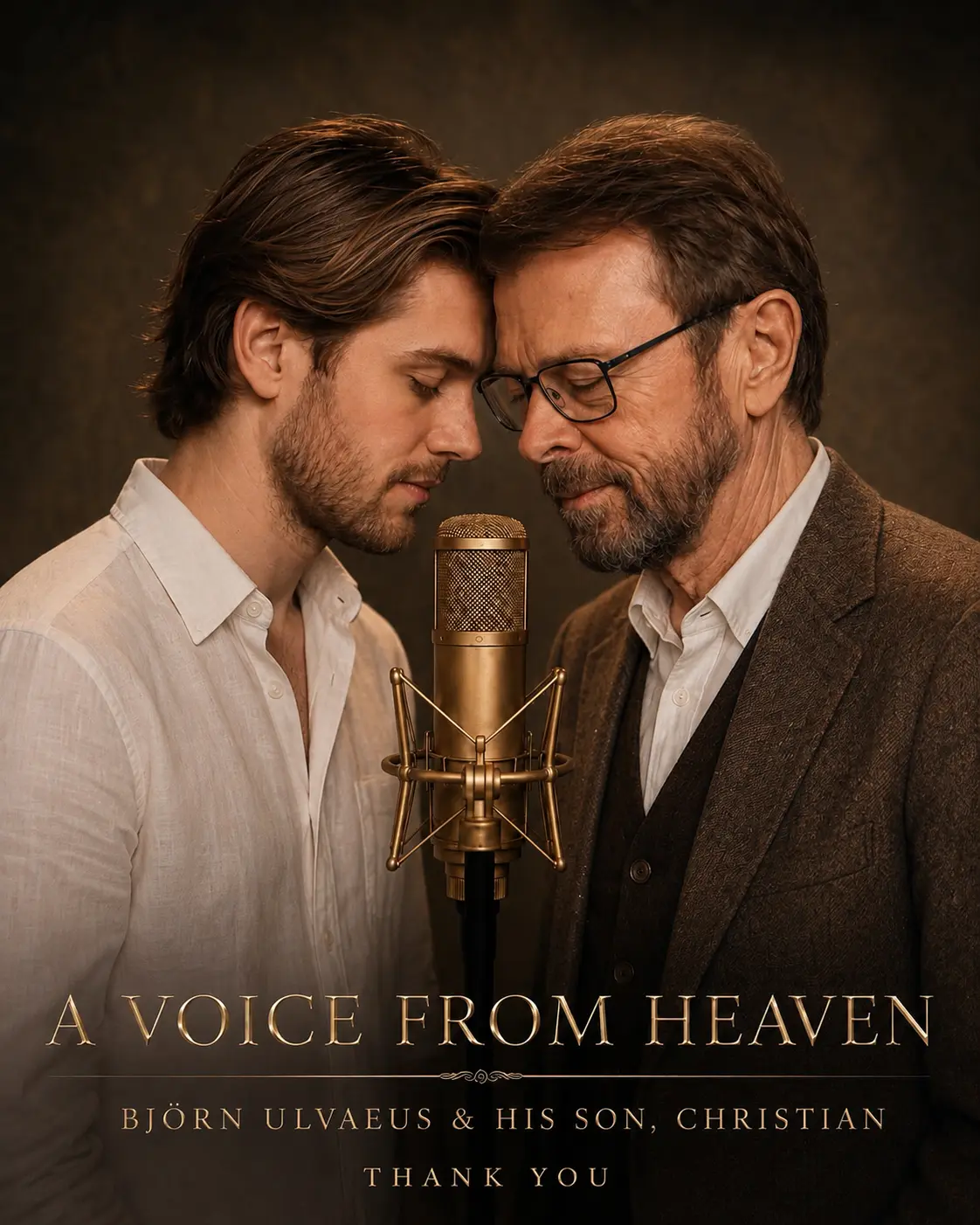
🎶 “A VOICE FROM HEAVEN”: Björn Ulvaeus and Son Christian at the Center of an Emotional Lost-Duet Mystery — The Song That Could Bridge Generations
An extraordinary story about a previously unheard father-son recording titled “You’re Still Here” has captured the imagination of ABBA admirers. But is the emotional duet genuine, and what would such a discovery mean for one of pop music's most celebrated families?


STOCKHOLM, SWEDEN — For generations, the music of ABBA has carried stories of love, separation, hope, and memories that refuse to fade. Now, an emotional account involving legendary songwriter Björn Ulvaeus and his son, Peter Christian Ulvaeus, is stirring curiosity among admirers of the Swedish pop group.
At the center of the story is a purported long-lost recording called “You're Still Here,” described as an intimate duet between father and son.
According to the circulating narrative, the recording was discovered in forgotten studio archives and features the voices of Björn and Christian blending together in a deeply personal musical performance.
The account presents the song as an extraordinary connection between two generations, transforming a private family moment into something audiences might experience through music.
However, the existence, discovery, and official release of this recording have not been independently verified. No authenticated recording credits, official release announcement, or reliable archival documentation accompanies the claim provided.
Even so, the story raises a fascinating question: What would it mean for audiences to hear such an intimate collaboration from a musician whose songs have shaped popular culture for more than half a century?
A Mysterious Song With an Emotional Title
The reported title, “You're Still Here,” immediately evokes themes that have appeared throughout Björn Ulvaeus's songwriting career.
Memory, attachment, love, and the passage of time are central to many of ABBA's most beloved songs.
The circulating description portrays the alleged duet as a musical conversation between father and son.
Björn's voice is described as warm and expressive, while Christian's is characterized as softer and more reflective.
Together, the two voices supposedly create a performance filled with nostalgia.
The narrative goes further, describing the recording as something that connects the past with the present.
Yet without an authenticated audio release, these descriptions cannot be assessed as factual observations about a real performance.
There is no verified basis for confirming the song's instrumentation, vocal arrangement, recording date, or production history.
For now, “You're Still Here” remains the title of an alleged recording rather than an established addition to the Ulvaeus musical catalog.
The Remarkable Musical Legacy of Björn Ulvaeus

Björn Ulvaeus occupies an extraordinary place in the history of popular music.
Born in Gothenburg, Sweden, in 1945, he became internationally famous as a member of ABBA, alongside Benny Andersson, Agnetha Fältskog, and Anni-Frid Lyngstad.
The group's breakthrough came with its Eurovision Song Contest victory in 1974, when “Waterloo” introduced ABBA to a vast international audience.
What followed was one of pop music's most remarkable success stories.
ABBA released a series of unforgettable hits, including “Dancing Queen,” “Mamma Mia,” “Fernando,” “Take a Chance on Me,” and “The Winner Takes It All.”
Behind the infectious melodies were sophisticated arrangements and lyrics that often explored complicated emotional experiences.
Ulvaeus and Andersson developed a songwriting partnership that helped define the sound of an era.
Their music combined accessible pop craftsmanship with themes that listeners could recognize in their own lives.
Decades later, those songs remain familiar to audiences who were not even born during ABBA's original years of success.
The group's legacy also expanded through the musical Mamma Mia!, its film adaptations, and the innovative ABBA Voyage concert experience.
For Ulvaeus, music has never been simply a collection of commercial recordings.
It has been a means of storytelling, preserving experiences, and communicating feelings across generations.
That history makes the idea of a personal father-son duet especially compelling.
Christian Ulvaeus: Growing Up With an Extraordinary Family History
Peter Christian Ulvaeus was born in 1977 to Björn Ulvaeus and Agnetha Fältskog, two of ABBA's four members.
His childhood was connected to one of the most famous musical families in Europe.
But growing up with internationally recognized parents is not necessarily the same as choosing a public career.
While Björn and Agnetha became household names through ABBA, their children have generally maintained much more private lives.
For fans, that privacy adds another layer of interest to stories involving Christian.
The possibility of hearing him participate in a previously unknown musical recording with his father naturally inspires curiosity.
Such a collaboration, if genuine, would offer an unusual intersection between ABBA's public musical history and the family's personal experiences.
However, Christian's relationship with his father should not be interpreted through unverified claims about a secret recording.
The alleged duet cannot establish previously unknown events in their family history without independent documentation.
The Fascination With Lost Studio Recordings
Music history contains numerous examples of recordings that were discovered, restored, or released years after their original creation.
Unfinished demos, alternative takes, private rehearsal tapes, and forgotten studio sessions can provide remarkable insights into how artists worked.
Sometimes these recordings reveal early versions of famous songs.
In other cases, they capture intimate performances never intended for commercial release.
The discovery of genuine archival material can therefore become an important cultural event.
For a group as extensively studied as ABBA, previously unknown recordings would attract particular attention.
Collectors, historians, producers, and longtime supporters would want to understand their origins.
An authentic discovery involving Björn Ulvaeus and Christian would raise several questions.
When was the recording made? Who wrote the song? Was it intended for a public release? Who preserved the original tapes? How was the material authenticated?
These details would be essential to establishing the recording's history.
The circulating story about “You're Still Here” provides an evocative description but does not supply verifiable answers.
Why a Father-Son Duet Would Be So Meaningful

Music often carries emotional significance within families.
A familiar melody can recall childhood memories, family celebrations, or moments shared between parents and children.
When relatives perform together, the result can have a different emotional character from an ordinary professional collaboration.
A father-son duet may symbolize shared experiences, generational continuity, and the ways personal identity develops through family relationships.
For a musician like Ulvaeus, whose work has reached millions, such a recording could also reveal a more private side of artistic expression.
Instead of composing for an international audience, a performer might be creating something intended primarily for someone close to them.
That possibility gives the reported story its emotional appeal.
The title “You're Still Here” also invites interpretations about memory and enduring relationships.
Importantly, however, it should not be taken as evidence of a death or tragedy. Both Björn Ulvaeus and Christian are described here as living individuals, and the phrase “a voice from heaven” is best understood as poetic language rather than a factual statement.
ABBA's Music Has Always Explored Family and Time
One reason the alleged recording feels connected to Ulvaeus's artistic legacy is that ABBA's songs have often reflected on relationships and change.
“Slipping Through My Fingers,” for example, explores the emotional experience of watching a child grow older and recognizing how quickly everyday moments pass.
Its themes have resonated with parents around the world.
Other songs, including “Our Last Summer” and “The Day Before You Came,” demonstrate the group's ability to evoke memory and reflection through carefully constructed storytelling.
These recordings helped establish ABBA as more than a collection of upbeat dance hits.
Their catalog contains an emotional range that continues to reward repeated listening.
A genuine father-son recording would naturally invite comparisons with that tradition.
Listeners might hear it as another expression of the relationship between music, memory, and personal experience.
But until an authenticated version becomes available, such comparisons remain hypothetical.
The Internet's Appetite for Emotional Music Discoveries
The online attention surrounding stories like “You're Still Here” reflects the enduring popularity of emotionally framed music news.
A mysterious archive, a legendary performer, a family connection, and a supposedly forgotten song create a powerful narrative.
The promise of hearing something previously hidden can be irresistible to longtime fans.
Yet the same elements can make unverified stories spread rapidly.
A dramatic description may be repeated across websites and social media before anyone confirms whether the recording exists.
For music lovers, the best way to evaluate such a claim is to look for official release information, credible interviews, recording credits, or documentation from recognized music archives.
An embedded video or sensational headline alone does not establish authenticity.
This matters especially when a story involves private family relationships.
A Legacy That Continues Beyond the Recording Studio
Björn Ulvaeus's influence on music is already extraordinary, regardless of whether the rumored duet proves authentic.
His songs have traveled across continents, languages, and generations.
They have been performed on concert stages, adapted for theater, featured in films, and rediscovered by younger listeners.
The continuing popularity of ABBA demonstrates how music can preserve emotional experiences long after the circumstances surrounding its creation have changed.
For fans, that enduring connection may be the most meaningful part of Ulvaeus's legacy.
His compositions have become part of countless family histories, accompanying important moments in people's lives.
In that sense, the idea of music connecting generations is not merely a dramatic metaphor.
It is something ABBA's catalog has already accomplished.
Final Thoughts: A Beautiful Story Awaiting Verification
The alleged duet “You're Still Here” has all the elements of a moving musical discovery: a legendary songwriter, his son, an intimate recording, and a message about enduring connection.
If authenticated, such a release could offer a fascinating addition to Björn Ulvaeus's artistic history.
But as of this article, there is no independently verified evidence establishing that the song was discovered or officially released.
The story should therefore be approached with curiosity rather than certainty.
What remains beyond dispute is the emotional power of the music Ulvaeus has already given the world.
Great songs have a remarkable ability to keep memories alive, connect families, and make distant moments feel close again.
And whether or not “You're Still Here” ever emerges as a genuine recording, the idea behind its reported title reflects something that ABBA's music has demonstrated for decades: the strongest musical connections can endure across generations.